Background: Why Have Some Customers Switched to Cut Wire Shot Even When Steel Shot Is More Suitable?
Through our discussions with customers, we have noticed an important trend: some customers whose workpieces, surface-finish requirements, and subsequent coating processes are better suited to spherical steel shot are actually using Cut Wire Shot.
Further investigation shows that these customers did not make the switch because cut wire shot was more suitable for their applications. Instead, they had previously purchased low-quality cast steel shot that broke down rapidly during use, generating excessive dust and fine particles and resulting in high abrasive consumption. After experiencing these problems, they concluded that all cast steel shot had poor durability and switched to the denser structure of cut wire shot.
Cut wire shot is manufactured by cutting steel wire and therefore generally does not contain casting defects such as internal cavities and shrinkage. As a result, it may offer better durability than low-quality cast steel shot. However, this does not mean that cut wire shot is necessarily more suitable for these customers, nor does it prove that all cast steel shot breaks down easily.
The real problem is not that Steel Shot itself lacks durability. Rather, these customers purchased low-quality steel shot containing excessive internal defects, inadequate heat treatment, or an improper balance between hardness and toughness.
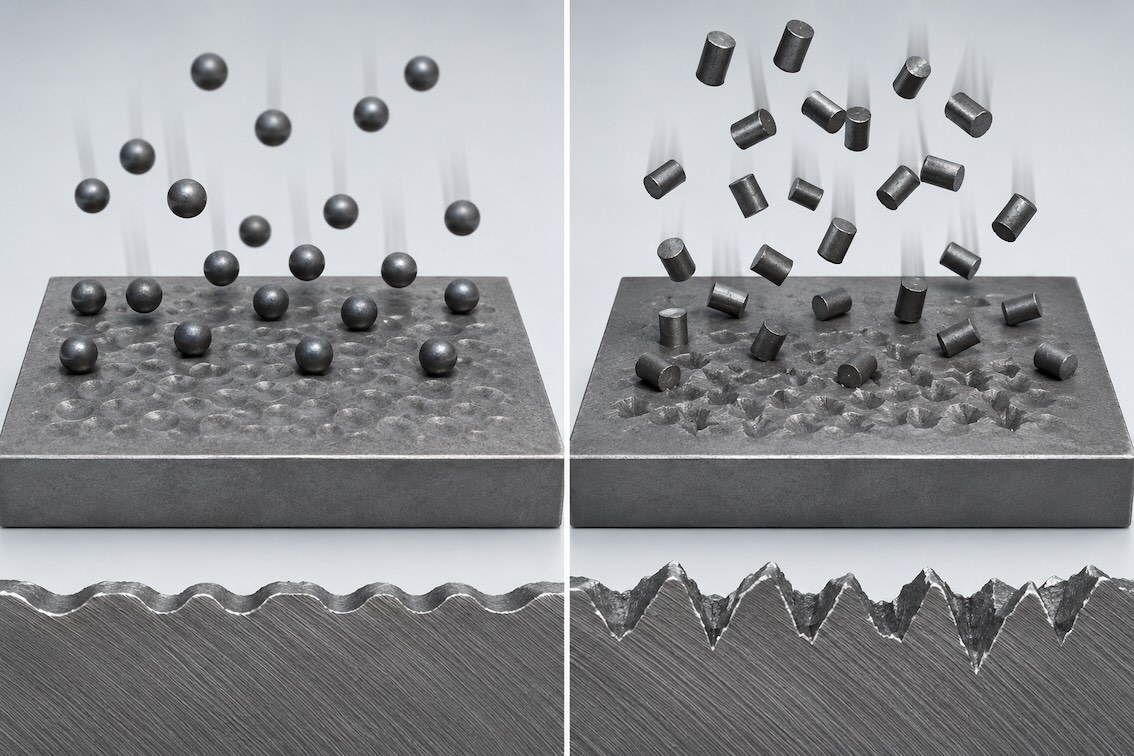
At the same time, unconditioned cut wire shot has a cylindrical shape with relatively sharp cut edges, giving it a stronger cutting action on the workpiece surface. When it is used on workpieces that would normally require spherical steel shot to achieve a uniform finish, it may create a deeper, sharper, and less consistent surface profile.
If the workpiece subsequently needs to be painted or coated, an excessively rough surface profile may increase coating consumption. If the profile peaks are not adequately covered, the risks of pinholes, pinpoint corrosion, and premature coating failure may also increase. Applying excessive coating to cover an overly deep surface profile can also contribute to sagging, uneven curing, and other coating defects.
Therefore, switching from low-quality steel shot to cut wire shot may temporarily solve the problem of rapid abrasive breakdown, but it does not necessarily reduce the total production cost. Customers should also consider:
- The required surface profile of the workpiece;
- Whether painting or coating is required after blasting;
- Paint or coating consumption;
- Wear on the Shot Blasting Equipment;
- Cleaning efficiency and processing time;
- The consistency of the final surface finish.
The right solution is not to abandon steel shot completely after experiencing problems with a low-quality product. Instead, customers should select high-quality steel shot that suits their workpieces and subsequent processes, with minimal internal defects, a homogeneous microstructure, stable hardness, sufficient toughness, and properly controlled heat treatment.
What Causes Steel Shot to Break Prematurely?
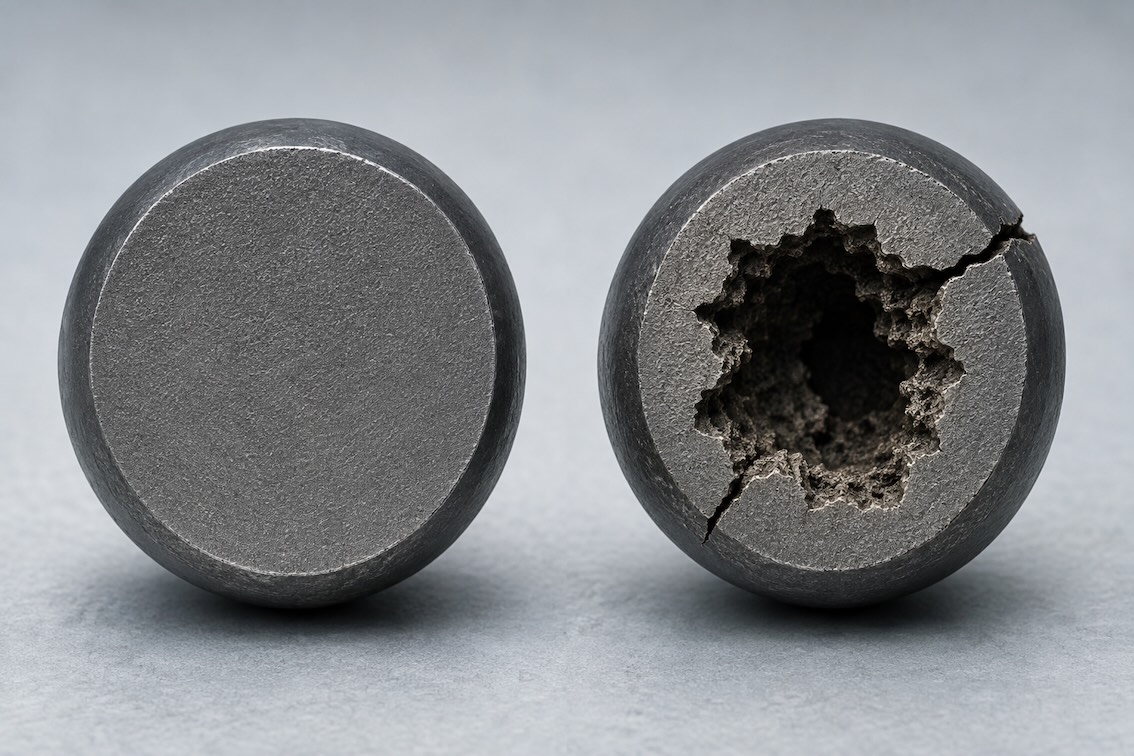
1. Internal Cavities and Shrinkage
Steel shot is produced from molten steel. If atomization, solidification and process control are inadequate, cavities or shrinkage defects may form inside the particles.
A hollow particle has a thinner load-bearing section and cannot distribute impact stress evenly. Under repeated blasting impacts, it is therefore more likely to collapse and break into small fragments.
High-quality steel shot should have high density and a low percentage of harmful internal cavities.
2. Cracks in the Steel Shot
Surface and internal cracks act as stress concentration points. Each time the steel shot strikes a workpiece, the crack may extend further until the particle breaks.
Industry standards allow only limited percentages of specified defects because completely eliminating every microscopic casting defect is difficult. The key difference is whether the manufacturer controls cracks, cavities and shrinkage within acceptable limits.
3. Inadequate Heat Treatment
Heat treatment is one of the most important stages in steel shot production. Simply forming spherical particles is not enough.
If quenching and tempering are insufficient or unstable, different parts of the same particle or different particles in the same batch may have significantly different hardness and toughness.
For Zhongxing ST Steel Shot, controlled secondary quenching and tempering are used to:
- Improve microstructural homogeneity.
- Reduce internal stress.
- Balance hardness and toughness.
- Increase resistance to repeated impact.
- Reduce premature breakage and dust generation.
4. Improper Blasting Parameters
Even high-quality steel shot can break faster under unsuitable operating conditions, such as:
- Excessively high wheel speed or blasting pressure.
- Using shot that is too large or too hard for the application.
- Poor abrasive separation and excessive accumulation of broken particles.
- An unstable operating mix.
- Severe contamination inside the blasting machine.
Therefore, steel shot quality and blasting conditions should be evaluated together.
Do Not Compare Abrasives Only by Purchase Price
The cheapest steel shot is not necessarily the lowest-cost abrasive, and the longest-lasting abrasive is not necessarily suitable for every surface requirement.
A proper cost comparison should include:
- Abrasive consumption per ton of workpieces.
- Cleaning speed and blasting cycle time.
- Electricity consumption.
- Dust generation and disposal.
- Wear on turbines, blades and other machine components.
- Surface roughness consistency.
- Paint or coating consumption.
- Rework and coating failure risk.
High-quality spherical steel shot can provide a more controlled surface profile, lower dust generation and more stable blasting performance. In many applications, these advantages result in a lower total processing cost than either low-quality cast shot or an incorrectly selected cut wire product.